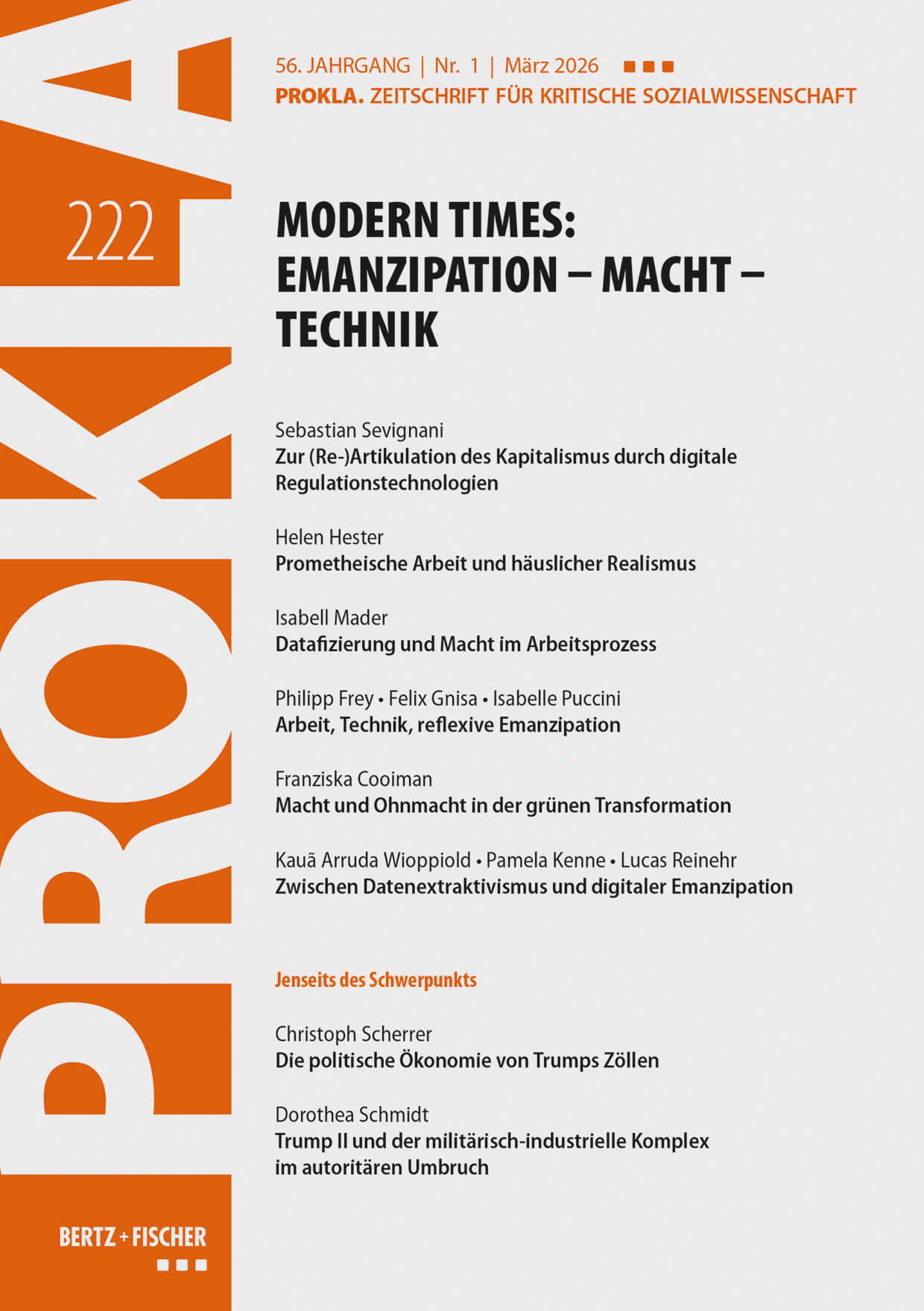
Datafication and Power in the Labour Process
DOI:
https://doi.org/10.32387/prokla.v56i222.2231Keywords:
Agency, Datafication, Digital Capitalism, Labour Process, PowerAbstract
In this article, I take a power-theoretical look at datafication in the labour process. Based on qualitative case studies, I explore the nexus between data and power at the micro level of social action by corporate actors. In doing so, I show how datafication can have different effects on the power of corporate actors depending on their position as subject or object in relation to the data collection process. A key finding is that work process data can be used not only as a management tool for process rationalisation and work control, but also as a means of power for workers.
Downloads
References
Arbeitskreis Strategic Unionism (2013): Jenaer Machtressourcenansatz 2.0. In: Schmalz, Stefan / Dörre, Klaus (Hg.): Comeback der Gewerkschaften? Machtressourcen, innovative Praktiken, internationale Perspektiven. Frankfurt/M.: 345-375.
Bain, Peter / Taylor, Phil (2000): Entrapped by the ›electronic panopticon‹? Worker resistance in the call centre. In: New Technology, Work and Employment 15(1): 2-18. DOI: https://doi.org/10.1111/1468-005X.00061. DOI: https://doi.org/10.1111/1468-005X.00061
Boes, Andreas u.a. (Hg.) (2022): Daten – Innovation – Privatheit. Mit Inverser Transparenz das Gestaltungsdilemma der digitalen Arbeitswelt lösen. München: Forschungsbericht des BMBF Verbundprojektes »Inverse Transparenz. Beteiligungsorientierte Ansätze für Datensouveränität«.
Boes, Andreas / Kämpf, Tobias (2023): Informatisierung und Informationsraum: Eine Theorie der digitalen Transformation. In: Carstensen, Tanja / Schaupp, Simon / Sevignani, Sebastian (Hg.): Theorien des digitalen Kapitalismus. Berlin: 141-161.
Boes, Andreas u.a. (2014): Informatisierung und neue Entwicklungstendenzen von Arbeit. In: Arbeits- und Industriesoziologische Studien 7(1): 5-23.
Bronowicka, Joanna / Ivanova, Mirela (2021): Resisting the Algorithmic Boss: Guessing, Gaming, Reframing and Contesting Rules in App-Based Management. In: Moore, Phoebe V. / Woodcock, Jamie (Hg.): Augmented exploitation. Artificial intelligence, automation and work. London: 149-162. DOI: https://doi.org/10.2307/j.ctv1h0nv3d.18. DOI: https://doi.org/10.2307/j.ctv1h0nv3d.18
Burawoy, Michael (1979): Manufacturing Consent. Changes in the Labor Process under Monopoly Capitalism. Chicago/London.
Calacci, Dan (2022): Organizing in the End of Employment: Information Sharing, Data Stewardship, and Digital Workerism. In: Kun, Andrew L. u.a. (Hg.): 2022 Symposium on Human-Computer Interaction for Work. CHIWORK 2022. New York: 1-9. DOI: https://doi.org/10.1145/3533406.3533424. DOI: https://doi.org/10.1145/3533406.3533424
Fessler, Agnes u.a. (2024): Digitalisierung, soziale Klasse und Ungleichheit – Homeoffice und das Forschungsprogramm von DigiCLASS. In: Pfeiffer, Sabine u.a. (Hg.): Digitalisierung der Arbeitswelten. Zur Erfassbarkeit einer systemischen Transformation. Wiesbaden: 161-180. DOI: https://doi.org/10.1007/978-3-658-44458-7_7. DOI: https://doi.org/10.1007/978-3-658-44458-7_7
Gautié, Jérôme / Jaehrling, Karen / Perez, Coralie (2020): Neo-Taylorism in the Digital Age: Workplace Transformations in French and German Retail Warehouses. In: Relations industrielles / Industrial Relations 75(4): 774-795. DOI: https://doi.org/10.7202/1074564ar. DOI: https://doi.org/10.7202/1074564ar
Gierlich-Joas, Maren / Hess, Thomas / Neuburger, Rahild (2020): More self-organization, more control – or even both? Inverse transparency as a digital leadership concept. In: Bus Res 13(3): 921-947. DOI: https://doi.org/10.1007/s40685-020-00130-0. DOI: https://doi.org/10.1007/s40685-020-00130-0
Hirschman, Albert O. (1970): Exit, Voice, and Loyalty: Responses to Decline in Firms, Organizations, and States. Cambridge/Mass./London.
Holzkamp, Klaus (1985): Grundlegung der Psychologie. Studienausgabe. Frankfurt/New York.
Kellogg, Katherine C. / Valentine, Melissa A. / Christin, Angéle (2020): Algorithms at Work: The New Contested Terrain of Control. In: Academy of Management Annals 14(1): 366-410. DOI: https://doi.org/10.5465/annals.2018.0174. DOI: https://doi.org/10.5465/annals.2018.0174
Köhne, Sonja / Klöpper, Miriam / Richthofen, Georg von / Send, Hendrik (2024): Autonomer dank Algorithmen? In: WSI Mitteilungen 77(1): 18-25. DOI: https://doi.org/10.5771/0342-300X-2024-1-18. DOI: https://doi.org/10.5771/0342-300X-2024-1-18
Krzywdzinski, Martin / Schneiß, Daniel / Sperling, Andrea (2025): Between control and participation: The politics of algorithmic management. In: New Technology, Work and Employment 40(1): 60-80. DOI: https://doi.org/10.1111/ntwe.12293. DOI: https://doi.org/10.1111/ntwe.12293
Kuhn, Thomas / Liggesmeyer, Peter (2019): Autonome Systeme. Potenziale und Herausforderungen. In: Hirsch-Kreinsen, Hartmut / Karacic, Anemari (Hg.): Autonome Systeme und Arbeit. Perspektiven, Herausforderungen und Grenzen der Künstlichen Intelligenz in der Arbeitswelt. Bielefeld: 27-45. DOI: https://doi.org/10.1515/9783839443958-003. DOI: https://doi.org/10.1515/9783839443958-003
Kunkel, Kalle (2025): »Langer Atem – keine Geduld mehr«. Der Kampf um die Krankenhäuser als politischer Tarifkonflikt. Hamburg.
Lücking, Stefan (2019): Arbeiten in der Plattformökonomie – Über digitale Tagelöhner, algorithmisches Management und die Folgen für die Arbeitswelt. Hans Böckler Stiftung. Düsseldorf.
Mader, Isabell (2022a): Herrschaft und Handlungsfähigkeit. Elemente einer kritischen Sozialtheorie. Frankfurt/New York.
– (2022b): Herrschaft und Handlungsfähigkeit in der Lohnarbeit. Eine Metastudie zu betrieblichen Machtordnungen. Frankfurt/New York.
Menz, Wolfgang / Nies, Sarah / Sauer, Dieter (2019): Digitale Kontrolle und Vermarktlichung. Beschäftigtenautonomie im Kontext betrieblicher Strategien der Digitalisierung. In: PROKLA 195 49(2): 181-200. DOI: https://doi.org/10.32387/prokla.v49i195.1808. DOI: https://doi.org/10.32387/prokla.v49i195.1808
Mettler, Tobias (2024): The connected workplace: Characteristics and social consequences of work surveillance in the age of datification, sensorization, and artificial intelligence. In: Journal of Information Technology 39(3): 547-567. DOI: https://doi.org/10.1177/02683962231202535. DOI: https://doi.org/10.1177/02683962231202535
Mohan, Robin (2025): Pflege zwischen Macht und Ohnmacht – Der Fachkräftemangel in Krankenhäusern. In: WSI Mitteilungen 78(2): 90-98. DOI: https://doi.org/10.5771/0342-300X-2025-2-90. DOI: https://doi.org/10.5771/0342-300X-2025-2-90
Nachtwey, Oliver / Staab, Philipp (2020): Das Produktionsmodell des digitalen Kapitalismus. In: Sabine Maasen und Jan-Hendrik Passoth (Hg.): Soziologie des Digitalen – Digitale Soziologie? Soziale Welt. Baden-Baden: 285-304. DOI: https://doi.org/10.5771/9783845295008-285
Nies, Sarah (2021): Eine Frage der Kontrolle? Betriebliche Strategien der Digitalisierung und die Autonomie von Beschäftigen in der Produktion. In: Berliner Journal für Soziologie 31: 475-504. DOI: https://doi.org/10.1007/s11609-021-00452-8. DOI: https://doi.org/10.1007/s11609-021-00452-8
Oesch, Daniel (2006): Redrawing the Class Map. Stratification and Institutions in Britain, Germany, Sweden and Switzerland. Houndsmills u.a. DOI: https://doi.org/10.1057/9780230504592. DOI: https://doi.org/10.1057/9780230504592
Rüb, Stefan (2021): Digitalisierung als Konfliktfeld betrieblicher Arbeitsbeziehungen. In: Buss, Klaus-Peter u.a. (Hg.): Digitalisierung und Arbeit. Triebkräfte – Arbeitsfolgen – Regulierung. Frankfurt/New York: 309-340.
Schaupp, Simon (2021): Technopolitik von unten. Algorithmische Arbeitssteuerung und kybernetische Proletarisierung. Berlin.
Schneider, Pauline / Struck, Olaf (2024): Digitale Technik und schwindende Machtressourcen in der Transportlogistik 4.0. In: WSI Mitteilungen 77(1): 3-9. DOI: https://doi.org/10.5771/0342-300X-2024-1-3. DOI: https://doi.org/10.5771/0342-300X-2024-1-3
Wood, Alex J. (2020): Despotism on Demand. How Power Operates in the Flexible Workplace. Ithaca/London. DOI: https://doi.org/10.7591/cornell/9781501748875.001.0001. DOI: https://doi.org/10.7591/cornell/9781501748875.001.0001
– (2021): Algorithmic Management: Consequences for Work Organisation and Working Conditions. European Commission. Seville.