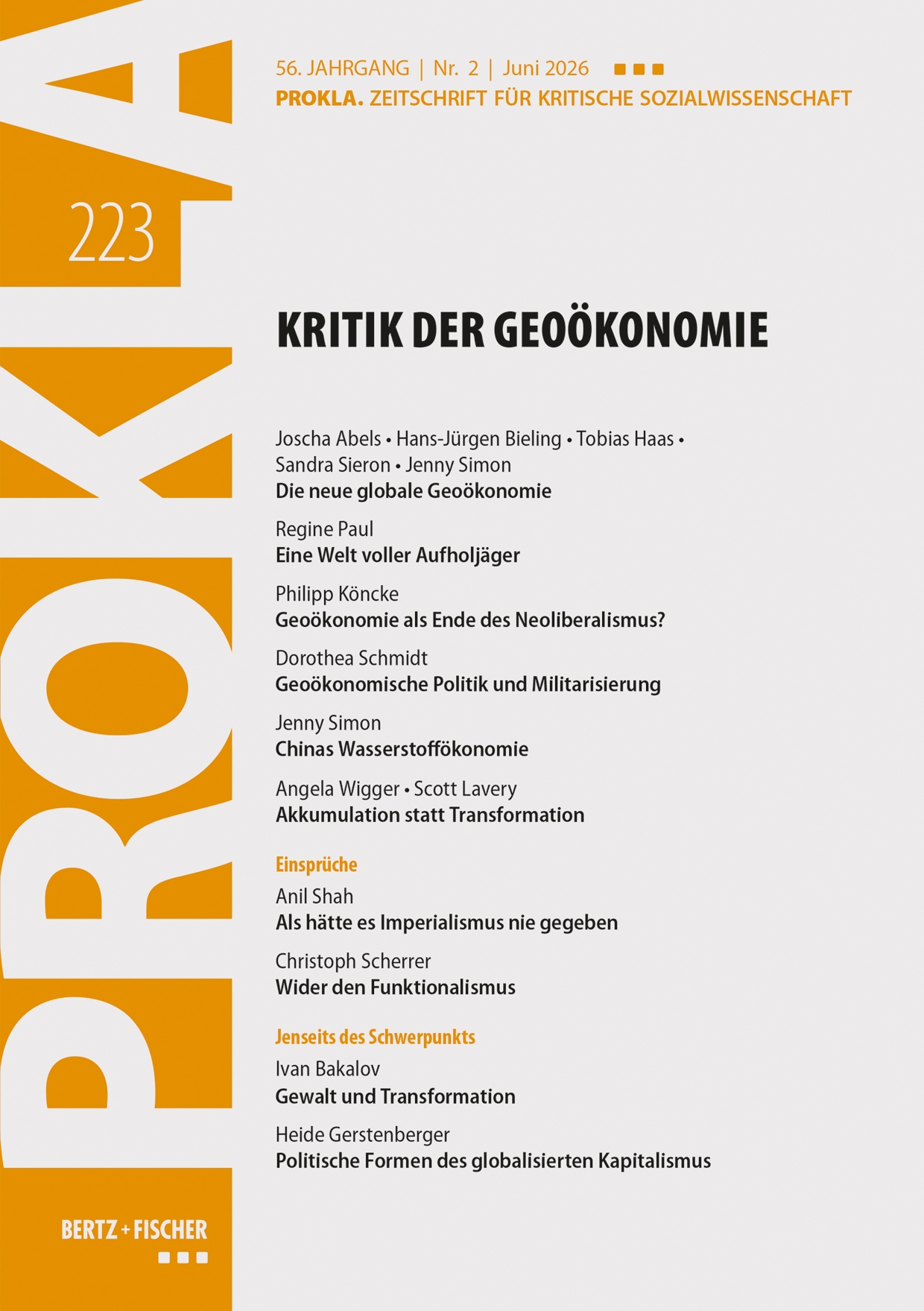
Geoökonomie als Ende des Neoliberalismus?
Zur Rekonfiguration von Staat und Globalisierung im USA-China-Konflikt
DOI:
https://doi.org/10.32387/prokla.v56i223.2239Schlagwörter:
Geoökonomie, Globalisierung, Neoliberalismus, USA-China-Konflikt, WettbewerbsstaatAbstract
Mit dem Beitrag interveniere ich in die Debatte um einen »geoökonomischen Staat« und problematisiere die gängige Deutung als Paradigmenbruch mit Neoliberalismus und Wettbewerbsstaat. Anhand des USA-China-Konflikts zeige ich, dass geoökonomische Politik der Sicherung technologischer Führungsposition und verbesserten Marktzugangs unter den Bedingungen intensivierter Weltmarktkonkurrenz dient. Hierzu historisiere ich die USA-China-Beziehungen und analysiere geoökonomische Reaktionen der USA, um Kontinuitäten und Brüche im Verhältnis von Staat und Ökonomie herauszuarbeiten. Geoökonomische Politik erweist sich dabei als Rekonfiguration neoliberaler Globalisierung im Rahmen des Wettbewerbsstaats.
Downloads
Literaturhinweise
Altvater, Elmar / Mahnkopf, Birgit (1996): Grenzen der Globalisierung: Ökonomie, Ökologie und Politik in der Weltgesellschaft. Münster.
American Chamber of Commerce in China (2018): 2018 American Business in China White Paper. URL: https://www.amchamchina.org/white_paper/2018-american-business-in-china-white-paper/, Zugriff: 20.4.2026.
Appelbaum, Richard (2009): Big suppliers in greater China. In: Hung, Ho-Fung (Hg.): China and the Transformation of Global Capitalism. Baltimore: 65-85.
Autor, David / Dorn, David / Hanson, Gordon (2016): The China Shock: Learning from Labor-Market Adjustment to Large Changes in Trade. In: Annual Review of Economics 8(1): 205-240. DOI: https://doi.org/10.1146/annurev-economics-080315-015041. DOI: https://doi.org/10.1146/annurev-economics-080315-015041
Babić, Milan (2025): Geoökonomie: Anatomie der neuen Weltordnung. Berlin.
– / Dixon, Adam D. / Liu, Imogen T. (2022): Geoeconomics in a Changing Global Order. In: dies. (Hg.): The Political Economy of Geoeconomics: Europe in a Changing World. Cham: 1-27. DOI: https://doi.org/10.1007/978-3-031-01968-5_1. DOI: https://doi.org/10.1007/978-3-031-01968-5_1
Baltz, Matthew (2017): Institutionalizing Neoliberalism: CFIUS and the Governance of Inward Foreign Direct Investment in the United States since 1975. In: Review of International Political Economy 24(5): 859-880. DOI: https://doi.org/10.1080/09692290.2017.1335650. DOI: https://doi.org/10.1080/09692290.2017.1335650
– (2022): What Lies Beneath the ›Tariff Man‹? The Trump Administration’s Response to China’s ›State Capitalism‹. In: Contemporary Politics 28(3): 328-346. DOI: https://doi.org/10.1080/13569775.2021.2022322. DOI: https://doi.org/10.1080/13569775.2021.2022322
Callahan, William (2005): How to Understand China: The Dangers and Opportunities of Being a Rising Power. In: Review of International Studies 31(4): 701-714. DOI: https://doi.org/10.1017/S0260210505006716. DOI: https://doi.org/10.1017/S0260210505006716
Campbell, Steven (2015): China’s Human Rights and US–China Economic Relations: Interest Group Lobbying and China’s MFN Trade Status. In: The International Journal of Social Sciences 33(1): 1-17.
Cerny, Philip (1997): Paradoxes of the Competition State: The Dynamics of Political Globalization. In: Government and Opposition 32(2): 251-274. DOI: https://doi.org/10.1111/j.1477-7053.1997.tb00161.x. DOI: https://doi.org/10.1111/j.1477-7053.1997.tb00161.x
Chow, Daniel (2010): China’s response to the global financial crisis: Implications for US-China economic relations. In: Global Business Law Review 1: 47-81.
Council on Foreign Relations (2025): Trump Approves China Chip Sales (9.12.). URL: https://www.cfr.org/articles/trump-approves-china-chip-sales-0?utm_, Zugriff: 20.4.2026.
Crouch, Colin (2011): Über das befremdliche Überleben des Neoliberalismus. Postdemokratie II. Berlin.
Farooki, Masuma / Kaplinsky, Raphael (2012): The Impact of China on Global Commodity Prices. The Global Reshaping of the Resource Sector. London. DOI: https://doi.org/10.4324/9780203155912. DOI: https://doi.org/10.4324/9780203155912
Farrell, Henry / Newman, Abraham (2023): The New Economic Security State: How De-risking Will Remake Geopolitics (19.10.). URL: https://www.foreignaffairs.com/united-states/economic-security-state-farrell-newman, Zugriff: 20.4.2026.
Ferguson, Niall / Schularick, Moritz (2007): ›Chimerica‹ and the global asset market boom. In: International Finance 10(3): 215-239. DOI: https://doi.org/10.1111/j.1468-2362.2007.00210.x. DOI: https://doi.org/10.1111/j.1468-2362.2007.00210.x
Fishman, Edward (2025): Chokepoints: American Power in the Age of Economic Warfare. New York.
Goh, Evelyn (2005): Constructing the US Rapprochement with China, 1961–1974: From ›Red Menace‹ to ›Tacit Ally‹. Cambridge. DOI: https://doi.org/10.1017/CBO9780511510472. DOI: https://doi.org/10.1017/CBO9780511510472
Harvey, David (2007): A Brief History of Neoliberalism. Oxford.
Hirsch, Joachim (1995): Der nationale Wettbewerbsstaat. Staat, Demokratie und Politik im globalen Kapitalismus. Berlin.
– (1998): Vom Sicherheits- zum nationalen Wettbewerbsstaat. Berlin.
Hung, Ho-Fung (Hg.) (2009): China and the Transformation of Global Capitalism. Baltimore. DOI: https://doi.org/10.56021/9780801893070. DOI: https://doi.org/10.56021/9780801893070
– (2022): Clash of empires: from ›Chimerica‹ to the ›New Cold War‹. Cambridge. DOI: https://doi.org/10.1017/9781108895897. DOI: https://doi.org/10.1017/9781108895897
Köncke, Philipp / Erlbacher, Lucas / Schmalz, Stefan (2025): The Anatomy of Chinese Capitalism: Sectoral Variation in Party-state Permeation and Corporate Governance. In: Competition & Change 30(2): 440-463. DOI: https://doi.org/10.1177/10245294251336510. DOI: https://doi.org/10.1177/10245294251336510
Köncke, Philipp / de Graaff, Nana (2024): Chinese Multinationals and Europe’s Geoeconomic Turn: The De‐Globalization of the Chinese ICT and Automotive Industry? In: Politics and Governance 12: 8195. DOI: https://doi.org/10.17645/pag.8195. DOI: https://doi.org/10.17645/pag.8195
Kraus, Richard (2012): The Cultural Revolution: A Very Short Introduction. Oxford. DOI: https://doi.org/10.1093/actrade/9780199740550.001.0001. DOI: https://doi.org/10.1093/actrade/9780199740550.001.0001
Kuo, L. Jay (1994): Farewell to Jackson-Vanik: The Case for Unconditional MFN Status for the People’s Republic of China. In: Asian Law Journal 1: 85-116.
Leoni, Zeno (2021): American Grand Strategy from Obama to Trump: Imperialism After Bush and China’s Hegemonic Challenge. Berlin. DOI: https://doi.org/10.1007/978-3-030-54742-4. DOI: https://doi.org/10.1007/978-3-030-54742-4
McNamara, Kathleen (2023): The Politics of European Industrial Policy: How A Post-neoliberal Shift is Transforming the European Union. Draft presented to GRIPE. URL: https://gripe.polisci.ucla.edu/wp-content/uploads/sites/121/2023/01/GRIPE_S0702, Zugriff: 20.4.2026.
Meijer, Hugo (2016): Trading with the Enemy: The Making of US Export Control Policy toward the People's Republic of China. Oxford. DOI: https://doi.org/10.1093/acprof:oso/9780190277697.001.0001
Meisner, Maurice (1999): Mao’s China and After: A History of the People’s Republic. New York.
Naughton, Barry (2006): The Chinese Economy: Transitions and Growth. Cambridge.
Pun, Ngai (2016): Migrant Labor in China: Post-socialist Transformations. London. DOI: https://doi.org/10.4000/chinaperspectives.6999
Rehmann, Jan (2025): Ein Milliardär mit Massenbasis: Trump und die Frage der Faschisierung in den USA. In: Zeitschrift Luxemburg. URL: https://zeitschrift-luxemburg.de/artikel/ein-milliardaer-mit-massenbasis/, Zugriff: 20.4.2026.
Roberts, Anthea / Moraes, Henrique / Ferguson, Victor (2019): Toward a Geoeconomic Order in International Trade and Investment. In: Journal of International Economic Law 22(4): 655-676. DOI: https://doi.org/10.1093/jiel/jgz036. DOI: https://doi.org/10.1093/jiel/jgz036
Scherrer, Christoph (2021): America Second. Die USA, China und der Weltmarkt. Berlin.
– (2026): Die politische Ökonomie von Trumps Zöllen: Macht statt Wirtschaft. In: PROKLA 222 56(1): 145-164. DOI: https://doi.org/10.32387/prokla.v56i222.2228. DOI: https://doi.org/10.32387/prokla.v56i222.2228
Schindler, Seth / Rolf, Steve (2025): Geostrategic Globalization: US-China Rivalry, Corporate Strategy, and the New Global Economy. In: Globalizations 22(6): 897-914. DOI: https://doi.org/10.1080/14747731.2024.2434306. DOI: https://doi.org/10.1080/14747731.2024.2434306
Schoppa, Leonard (1997): Bargaining with Japan: What American Pressure Can and Cannot Do. New York.
Schurmann, Franz (1966): Ideology and Organization in Communist China. Oakland.
Seidl, Timo / Schmitz, Luuk (2024): Moving on to not fall behind? Technological sovereignty and the ›geo-dirigiste‹ turn in EU industrial policy. In: Journal of European Public Policy 31(8): 2147-2174. DOI: https://doi.org/10.1080/13501763.2023.2248204. DOI: https://doi.org/10.1080/13501763.2023.2248204
Trump, Donald J. (2017): Remarks by President Trump at APEC CEO Summit. Da Nang, Vietnam. In: Foreign Policy. URL: https://web.archive.org/web/20180218061210/https://www.whitehouse.gov/briefings-statements/remarks-president-trump-apec-ceo-summit-da-nang-vietnam/, Zugriff: 20.4.2026.
US Census Bureau (2026): Trade in Goods with China. URL: https://www.census.gov/foreign-trade/balance/c5700.html, Zugriff: 20.4.2026.
US Department of Defense (2016): 2016 – Military and Security Developments Involving the People’s Republic of China. URL: https://www.ustaiwandefense.com/wp-content/uploads/2025/02/2016-Military-and-Security-Developments-Involving-the-Peoples-Republic-of-China.pdf, Zugriff: 20.4.2026.
USTR (2018): USTR Issues Tariffs on Chinese Products in Response to Unfair Trade Practices. URL: https://ustr.gov/about-us/policy-offices/press-office/press-releases/2018/june/ustr-issues-tariffs-chinese-products, Zugriff: 20.4.2026.
– (2020): Economic and Trade Agreement Between the United States of America and the People’s Republic of China (Phase One Agreement), January 2020. URL: https://ustr.gov/sites/default/files/files/agreements/phase%20one%20agreement/Economic_And_Trade_Agreement_Between_The_United_States_And_China_Text.pdf, Zugriff: 20.4.2026.
– (2024): Four-Year Review of Actions Taken in the Section 301 Investigation: China’s Acts, Policies, and Practices Related to Technology Transfer, Intellectual Property, and Innovation. URL: https://ustr.gov/sites/default/files/USTR%20Report%20Four%20Year%20Review%20of%20China%20Tech%20Transfer%20Section%20301.pdf?utm_, Zugriff: 20.4.2026.
Wagreich, Samuel (2013): Lobbying by Proxy: A Study of China’s Lobbying Practices in the United States, 1979–2010 and the Implications for FARA. In: Journal of Politics and Society 24(1): 130-160.
White House (2025): Fact Sheet: President Donald J. Trump Strikes Deal on Economic and Trade Relations with China. URL: https://www.whitehouse.gov/fact-sheets/2025/11/fact-sheet-president-donald-j-trump-strikes-deal-on-economic-and-trade-relations-with-china/?utm_, Zugriff: 20.4.2026.
Xiao, Mark / Zhao, Xinhua (2018): Impact of China removing foreign ownership restrictions on the automotive industry. URL: https://www.chinalawinsight.com/2018/07/articles/corporate-ma/19073/?utm_, Zugriff: 20.4.2026.