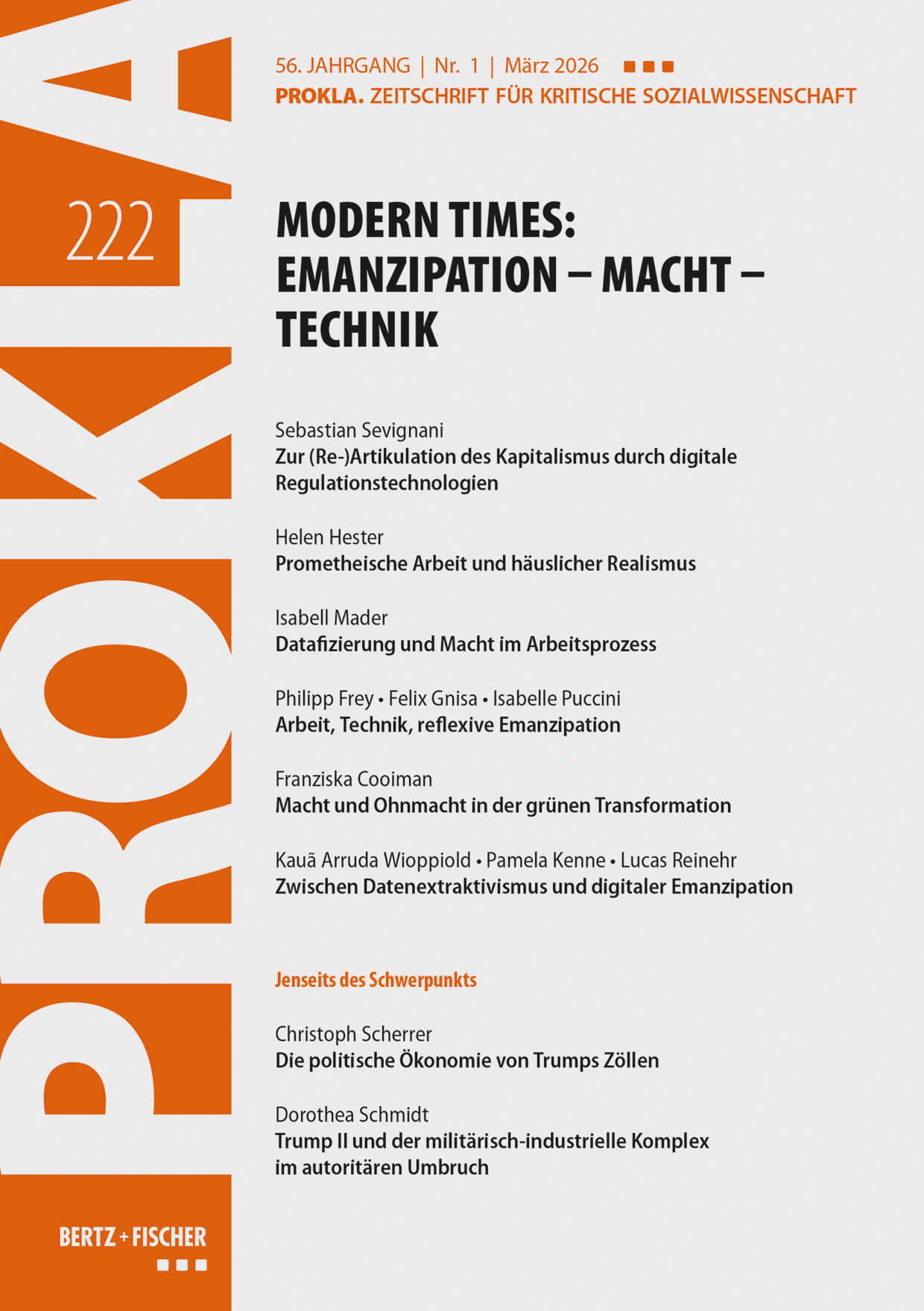
Zur (Re-)Artikulation des Kapitalismus durch digitale Regulationstechnologien
DOI:
https://doi.org/10.32387/prokla.v56i222.2229Schlagwörter:
Artikulation von Produktionsweisen, digitaler Kapitalismus, intellektuelle Monopolisierung, maschinelles Lernen, TätigkeitstheorieAbstract
In dem Beitrag bestimme ich die Rolle digitaler Technologien im Kapitalismus produktivkrafttheoretisch mit Bezug auf die Tätigkeitstheorie als Regulationstechnologien, die heute als Lernmaschinen in großen Datensätzen Regelmäßigkeiten erkennen, vorhersagen und produzieren können. Dies erlaubt die innere Artikulation des Kapitalismus – vertikal zwischen einem »Anti-Markt«, der sich über die marktvermittelte und moralische Ökonomie erhebt und horizontal zwischen einem Kern und seinen ermöglichenden reproduktiven Außenbereichen – in neuer Weise. Abschließend wird nach Implikationen dieser Perspektive für eine emanzipatorische Technikpolitik gefragt.
Downloads
Literaturhinweise
Alnasseri, Sabah (2003): Ursprüngliche Akkumulation, Artikulation und Regulation. Aspekte einer globalen Theorie der Regulation. In: Brand, Ulrich / Raza, Werner (Hg.): Fit für den Postfordismus? Theoretisch-politische Perspektiven des Regulationsansatzes. Münster: 131-157.
Angelis, Massimo de (2017): Omnia Sunt Communia: On the Commons and the Transformation to Postcapitalism. London.
Arievitch, Igor M. / Stetsenko, Anna (2014): The »magic of signs«: Developmental trajectory of cultural mediation. In: Yasnitsky, Anton / Ferrari, Michel / van der Veer, René (Hg.): The Cambridge Handbook of Cultural-Historical Psychology. Cambridge: 217-244. DOI: https://doi.org/10.1017/CBO9781139028097.013. DOI: https://doi.org/10.1017/CBO9781139028097.013
Banaji, Jairus (2013): Modes of production. In: Fine, Ben / Saad-Filho, Alfredo (Hg.): The Elgar Companion to Marxist Economics. Cheltenham: 227-232. DOI: https://doi.org/10.4337/9781781001226.00042. DOI: https://doi.org/10.4337/9781781001226.00042
Bhattacharya, Tithi (Hg.) (2017): Social Reproduction Theory: Remapping Class, Recentring Oppression. London. DOI: https://doi.org/10.2307/j.ctt1vz494j. DOI: https://doi.org/10.2307/j.ctt1vz494j
Boes, Andreas / Kämpf, Tobias / Ziegler, Alexander (2020): Arbeit im Informationsraum – Informatisierung als Perspektive für ein soziologisches Verständnis der digitalen Transformation. In: Soziale Welt Sonderband 23: 305-325. DOI: https://doi.org/10.5771/9783845295008-305. DOI: https://doi.org/10.5771/9783845295008-305
Braudel, Fernand (1977): Afterthoughts on Material Civilization and Capitalism. Baltimore.
Bria, Francesca / Timmers, Paul / Gernone, Fausto (2025): EuroStack – A European Alternative for Digital Sovereignty. URL: https://www.ucl.ac.uk/bartlett/publications/2025/feb/eurostack-european-alternative-digital-sovereignty, Zugriff: 3.5.2025.
Butollo, Florian / Feuerstein, Patrick / Krzywdzinski, Martin (2021): Was zeichnet die digitale Transformation der Arbeitswelt aus? Ein Deutungsangebot jenseits von Großtheorien und disparater Empirie. In: Arbeits- und Industriesoziologische Studien 14(2): 27-44.
Butollo, Florian / Schneidemesser, Lea (2022): Who runs the show in digitalized manufacturing? Data, digital platforms and the restructuring of global value chains. In: Global Networks 22(4): 595-614. DOI: https://doi.org/10.1111/glob.12366. DOI: https://doi.org/10.1111/glob.12366
Carstensen, Tanja, Simon Schaupp, Sebastian Sevignani (Hg.) (2023): Theorien des digitalen Kapitalismus: Arbeit und Ökonomie, Politik und Subjekt. Berlin.
Crawford, Kate (2025): Eating the Future: The Metabolic Logic of AI Slop. URL: https://www.e-flux.com/architecture/intensification/6782975/eating-the-future-the-metabolic-logic-of-ai-slop, Zugriff: 18.10.2025.
Dahme, Christian, Arne Raeithel (1997): Ein tätigkeitstheoretischer Ansatz zur Entwicklung von brauchbarer Software. In: Informatik-Spektrum 20(1): 5-12. DOI: https://doi.org/10.1007/s002870050046. DOI: https://doi.org/10.1007/s002870050046
Dolata, Ulrich (2024): Industrieplattformen. Eine neue Form der Handlungskoordination in der Wirtschaft. SOI Discussion Paper, 2024-91. URL: https://www.ssoar.info/ssoar/bitstream/handle/document/90824/ssoar-2024-dolata-Industrieplattformen_Eine_neue_Form_der.pdf?sequence=1&isAllowed=y&lnkname=ssoar-2024-dolata-Industrieplattformen_Eine_neue_Form_der.pdf, Zugriff: 12.1.2026.
Durand, Cédric / Milberg, Wiliiam (2020): Intellectual monopoly in global value chains. In: Review of International Political Economy 27(2): 404-429. DOI: https://doi.org/10.1080/09692290.2019.1660703. DOI: https://doi.org/10.1080/09692290.2019.1660703
Dyer-Witheford, Nick / Mikkola Kjosen, Atle / Steinhoff, James (2019): Inhuman Power: Artificial Intelligence and the Future of Capitalism. London. DOI: https://doi.org/10.2307/j.ctvj4sxc6. DOI: https://doi.org/10.2307/j.ctvj4sxc6
Elder-Vass, Dave (2019): Appropriative practices and the ontology of economic form. In: Teoria e Cultura 14(2): 131-143. DOI: https://doi.org/10.34019/2318-101X.2019.v14.27894. DOI: https://doi.org/10.34019/2318-101X.2019.v14.27894
Fraser, Nancy (2023): Der Allesfresser. Wie der Kapitalismus seine eigenen Grundlagen verschlingt. Berlin.
Friedrich, Janette (2014): Vygotsky’s idea of psychological tools. In: Yasnitsky, Anton / Ferrari, Michel / van der Veer, René (Hg.): The Cambridge Handbook of Cultural-Historical Psychology Cambridge: 47-62. DOI: https://doi.org/10.1017/CBO9781139028097.004. DOI: https://doi.org/10.1017/CBO9781139028097.004
Fuchs, Christian (2024): Theorien des digitalen Kapitalismus. In: Ernst, Christoph u.a. (Hg.): Handbuch Medientheorien im 21. Jahrhundert. Wiesbaden: 1-24. DOI: https://doi.org/10.1007/978-3-658-38128-8_21-1. DOI: https://doi.org/10.1007/978-3-658-38128-8_21-1
– / Unterberger, Klaus (2021): The Public Service Media and Public Service Internet Manifesto. University of Westminster. DOI: https://doi.org/10.16997/book60. DOI: https://doi.org/10.16997/book60
Fuchs-Kittowski, Klaus / Stary, Christian (2024): Wie entsteht Information, wo kommt ihre Bedeutung her? Zum Verständnis von Information in der digitalen Gesellschaft mit KI Systemen wie ChatGPT. In: Leibniz Online 52: 1-36. DOI: https://doi.org/10.53201/LEIBNIZONLINE52.
Graf, Jakob (2024): Die politische Ökonomie der »Überflüssigen«: Sozialökologische Konflikte und die Kämpfe der Mapuche gegen die Forstindustrie in Chile. Wiesbaden. DOI: https://doi.org/10.1007/978-3-658-43536-3. DOI: https://doi.org/10.1007/978-3-658-43536-3
Groos, Jan / Christoph Sorg (2025): Creative Construction: Democratic Planning in the 21st Century and Beyond. Bristol. DOI: https://doi.org/10.1332/policypress/9781529235128.001.0001. DOI: https://doi.org/10.1332/policypress/9781529235128.001.0001
Haug, Wolfgang Fritz (2020): Online-Kapitalismus. Eine forschende Auseinandersetzung mit Staabs »Digitalen Kapitalismus«. In: Das Argument 335: 19-56.
Jessop, Bob (2007): Knowledge as a fictitious Commodity: Insights and Limits of a Polanyian Perspective. In: Bugra, Ayse / Agartan, Kaan (Hg.): Reading Karl Polanyi for the Twenty-First Century. New York: 115-134. DOI: https://doi.org/10.1057/9780230607187_7. DOI: https://doi.org/10.1057/9780230607187_7
Jochum, Georg / Schaupp, Simon (2019): Die Steuerungswende. Zur Möglichkeit einer nachhaltigen und demokratischen Wirtschaftsplanung im digitalen Zeitalter. In: Butollo, Florian / Nuss, Sabine (Hg.): Marx und die Roboter: Vernetzte Produktion, künstliche Intelligenz und lebendige Arbeit. Berlin: 327-344.
Krämer, Sybille (2025): Der Stachel des Digitalen: Geisteswissenschaften und Digital Humanities. Berlin.
Likavčan, Lukáš / Scholz-Wäckerle, Manuel (2022): The Stack as an Integrative Model of Global Capitalism. In: tripleC 20(2): 147-162. DOI: https://doi.org/10.31269/triplec.v20i2.1343 DOI: https://doi.org/10.31269/triplec.v20i2.1343
Malsch, Thomas (1987): Arbeit und Kommunikation im informatisierten Produktionsprozeß. In: Lutz, Burkart (Hg.): Technik und sozialer Wandel: Verhandlungen des 23. Deutschen Soziologentages in Hamburg 1986. Frankfurt/M.: 164-175.
MEW – Marx, Karl / Engels, Friedrich: Marx-Engels-Werke. Berlin 1956ff.
Mattelart, Armand (2003): Kleine Geschichte der Informationsgesellschaft. Berlin.
Meretz, Stefan (2019): Kategoriale Grundlagen einer postmonetären Gesellschaft. In: Projektgruppe »Gesellschaft nach dem Geld« (Hg.): Postmonetär denken: Eröffnung eines Dialogs. Wiesbaden: 265-294. DOI: https://doi.org/10.1007/978-3-658-21706-8_9. DOI: https://doi.org/10.1007/978-3-658-21706-8_9
Muldoon, James / Graham, Mark / Cant, Callum (2024): Feeding the Machine: The Hidden Human Labour Powering AI. Edinburgh.
Nachtwey, Oliver / Staab, Philipp (2020): Das Produktionsmodell des digitalen Kapitalismus. In: Soziale Welt Sonderband 23: 285-304. DOI: https://doi.org/10.5771/9783845295008-285. DOI: https://doi.org/10.5771/9783845295008-285
Nake, Frieder (1992): Informatik und die Maschinisierung von Kopfarbeit. In: Coy, Wolfgang u.a. (Hg.): Sichtweisen der Informatik. Wiesbaden/Braunschweig: 181-201. DOI: https://doi.org/10.1007/978-3-322-84926-7_14. DOI: https://doi.org/10.1007/978-3-322-84926-7_14
– (2021): Algorithmen & Zeichen. Beiträge von Frieder Nake zur Gegenwart des Computers. Berlin.
Nassehi, Armin (2019): Muster: Theorie der digitalen Gesellschaft. München. DOI: https://doi.org/10.17104/9783406740251. DOI: https://doi.org/10.17104/9783406740251
Pagano, Ugo (2014): The crisis of intellectual monopoly capitalism. In: Cambridge Journal of Economics 38(6): 1409-1429. DOI: https://doi.org/10.1093/cje/beu025. DOI: https://doi.org/10.1093/cje/beu025
Pasquinelli, Matteo (2023): The Eye of the Master: A Social History of Artificial Intelligence. London.
Peck, Jamie / Phillips, Rachel (2020): The Platform Conjuncture. In: Sociologica 14(3): 73-99. DOI: https://doi.org/10.6092/issn.1971-8853/11613.
Pfeiffer, Sabine (2021): Digitalisierung als Distributivkraft: Über das Neue am digitalen Kapitalismus. Bielefeld. DOI: https://doi.org/10.1515/9783839454220. DOI: https://doi.org/10.1515/9783839454220
Raeithel, Arne (1998): Selbstorganisation, Kooperation, Zeichenprozess: Arbeiten zu einer kulturwissenschaftlichen anwendungsbezogenen Psychologie. Wiesbaden. DOI: https://doi.org/10.1007/978-3-663-07986-6. DOI: https://doi.org/10.1007/978-3-663-07986-6
Raffetseder, Eva-Maria / Schaupp, Simon / Staab, Philipp (2017): Kybernetik und Kontrolle. Algorithmische Arbeitssteuerung und betriebliche Herrschaft. In: PROKLA 187 47(2): 229-247. DOI: https://doi.org/10.32387/prokla.v47i187.143. DOI: https://doi.org/10.32387/prokla.v47i187.143
Reitz, Tilman / van den Ecker, Marlen / Sevignani, Sebastian (2025): The Common Production of Economic Advantages. Towards an Activity Theory of Rent in Informational Capitalism. In: Critical Sociology: 08969205251394644. DOI: https://doi.org/10.1177/08969205251394644. DOI: https://doi.org/10.1177/08969205251394644
– (2023): Eigentum im digitalen Kapitalismus. Ökonomie, Recht und Praxis. In: Carstensen, Tanja / Schaupp, Simon / Sevignani, Sebastian (Hg.): Theorien des Digitalen Kapitalismus. Berlin: 264-284.
Rikap, Cecilia (2021): Capitalism, Power and Innovation: Intellectual Monopoly Capitalism Uncovered. New York. DOI: https://doi.org/10.4324/9780429341489. DOI: https://doi.org/10.4324/9780429341489
– (2023): Rethinking Monopoly as a Power Relation: The Shift from Market to Intellectual Monopoly. CITYPERC Working Paper No. 2023-01. London.
– u.a. (2024): Reclaiming digital sovereignty: A roadmap to build a digital stack for people and the planet. URL: https://lutpub.lut.fi/handle/10024/168600, Zugriff: 21.3.2025.
Schaupp, Simon (2024): Stoffwechselpolitik: Arbeit, Natur und die Zukunft des Planeten. Berlin.
Schmiede, Rudi (1996): Informatisierung, Formalisierung und kapitalistische Produktionsweise: Entstehung der Informationstechnik und Wandel der gesellschaftlichen Arbeit. In: Ders. (Hg.): Virtuelle Arbeitswelten. Arbeit, Produktion und Subjekt in der »Informationsgesellschaft«. Berlin: 15-47.
Schneider, Etienne / Syrovatka, Felix (Hg.) (2024): Politische Ökonomie der Zeitenwende: Perspektiven der Regulationstheorie. Münster.
Schulz, Peter (2026): Explain! Automatisierung personalen Wissens in der naturwissenschaftlichen Wissensarbeit. In: Arbeit 35(1): im Erscheinen. DOI: https://doi.org/10.1515/arbeit-2026-0002
Schwartz, Herman Mark (2022): From Fordism to franchise. Intellectual property and growth models in the knowledge economy. In: Baccaro, Lucio/ Blyth, Mark / Pontusson, Jonas (Hg.): Diminishing Returns: The New Politics of Growth and Stagnation. Oxford: 74-97. DOI: https://doi.org/10.1093/oso/9780197607855.003.0003. DOI: https://doi.org/10.1093/oso/9780197607855.003.0003
Sevignani, Sebastian (2019): Digitale Arbeit und Prosumption im Kapitalismus. In: Butollo, Florian / Nuss, Sabine (Hg.): Marx und die Roboter: Vernetzte Produktion, künstliche Intelligenz und lebendige Arbeit. Berlin: 293-310.
– (2024): Communicative Activity: Social Theoretical Foundations for Critical Materialist Media and Communication Sociology in the Digital Age. In: Critical Sociology 50(4-5): 707-725. DOI: https://doi.org/10.1177/08969205241230246. DOI: https://doi.org/10.1177/08969205241230246
– (2025): Activity Theory in the Digital Age: Can communication and data be expropriated, exploited, or alienated? In: Bilić, Paško / Allmer, Thomas (Hg.): Rethinking Media and Communication: A Critical Sociological Lens. Leiden: 204-228.
– / Theine, Hendrik / Tröger, Mandy (2025): Toward Media Environment Capture: A Theoretical Contribution on the Influence of Big Tech on News Media. In: International Journal of Communication 19(2025): 804-824.
Sorg, Christoph (2023): Failing to Plan Is Planning to Fail: Toward an Expanded Notion of Democratically Planned Postcapitalism. In: Critical Sociology 49(3): 475-493. DOI: https://doi.org/10.1177/08969205221081058. DOI: https://doi.org/10.1177/08969205221081058
Talbot, John M. (2011): The Coffee Commodity Chain in the World-Economy: Arrighi’s Systemic Cycles and Braudel’s Layers of Analysis. In: Journal of World-Systems Research: 58-88. DOI: https://doi.org/10.5195/jwsr.2011.427. DOI: https://doi.org/10.5195/jwsr.2011.427
Tikhomirov, Oleg K. (1981): The Psychological Consequences of Computerization. In: Wertsch, James V. (Hg.): The Concept of Activity in Soviet Psychology. New York: 256-278. DOI: https://doi.org/10.4324/9781003575429-8. DOI: https://doi.org/10.4324/9781003575429-8
Tuomi, Ilkka (2018): Vygotsky Meets Backpropagation. In: Penstein Rosé, Carolyn u.a. (Hg.): Artificial Intelligence in Education. Cham: 570-583. DOI: https://doi.org/10.1007/978-3-319-93843-1_42. DOI: https://doi.org/10.1007/978-3-319-93843-1_42
Voß, G. Günter (2020): Der arbeitende Nutzer: Über den Rohstoff des Überwachungskapitalismus. Frankfurt/New York.
Wallerstein, Immanuel (1991): Braudel on Capitalism, or Everything Upside Down. In: The Journal of Modern History 63(2): 354-361. DOI: https://doi.org/10.1086/244319. DOI: https://doi.org/10.1086/244319
Wolff, Bernd u.a. (1999): Organisationstheorie als Fenster zur Wirklichkeit. In: Becker, Jörg u.a. (Hg.): Wirtschaftsinformatik und Wissenschaftstheorie: Bestandsaufnahme und Perspektiven. Wiesbaden: 289-327. DOI: https://doi.org/10.1007/978-3-322-82411-0_9. DOI: https://doi.org/10.1007/978-3-322-82411-0_9
Zuboff, Shoshana (2019): Surveillance Capitalism and the Challenge of Collective Action. In: New Labor Forum 28(1): 10-29. DOI: https://doi.org/10.1177/1095796018819461. DOI: https://doi.org/10.1177/1095796018819461