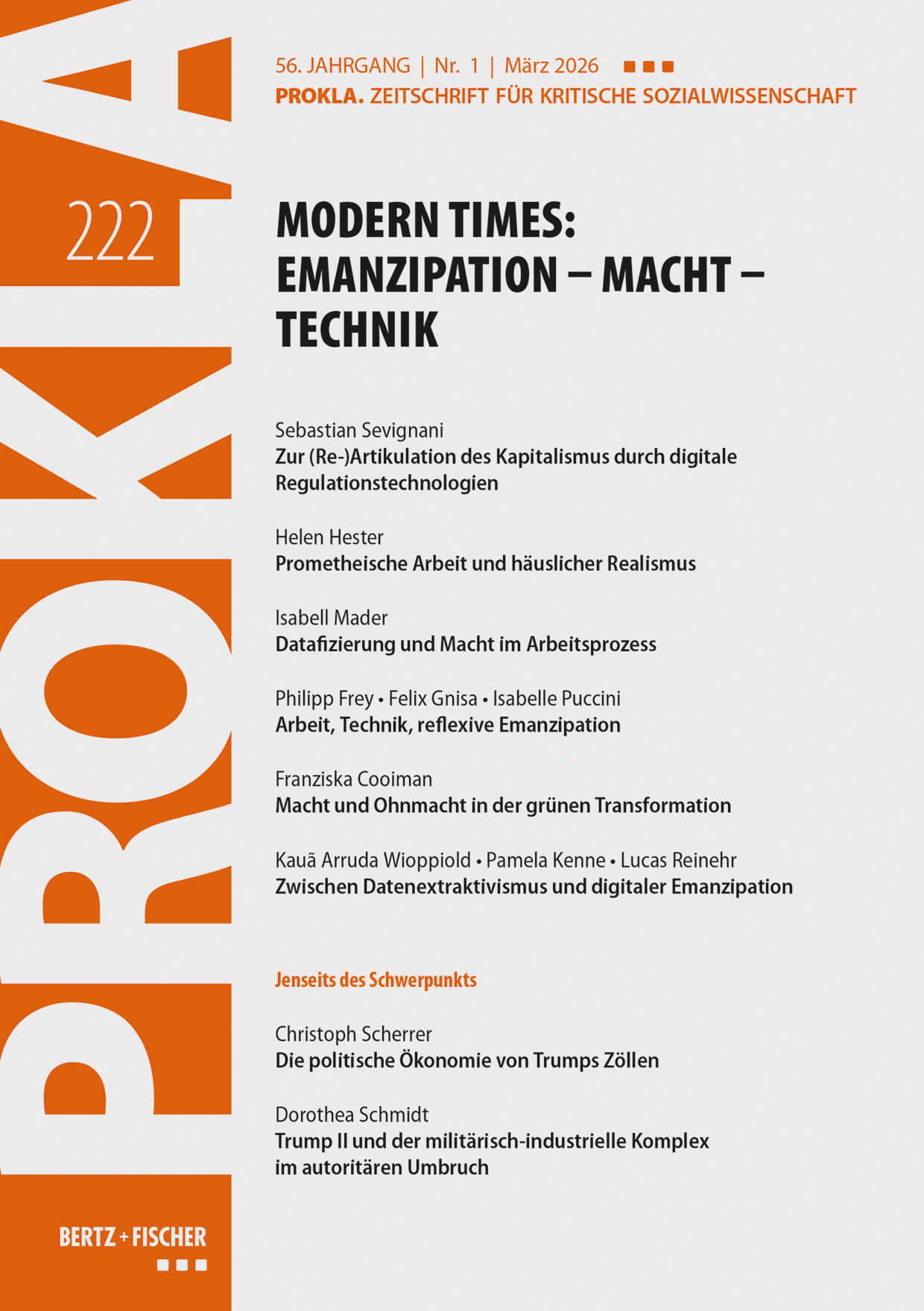
Macht und Ohnmacht in der grünen Transformation
Wie Wagniskapital den technologischen Möglichkeitsraum strukturiert
DOI:
https://doi.org/10.32387/prokla.v56i222.2220Schlagwörter:
Grüne Transformation, Investitionsketten, Start-ups, Technologie, WagniskapitalAbstract
In diesem Beitrag untersuche ich, wie Wagniskapital die grüne Transformation prägt. Ich zeige anhand einer Analyse von Machtverhältnissen in Investitionsketten, wie Wagniskapital den technologischen Möglichkeitsraum gesellschaftlicher Entwicklung formt. Investoren fördern vor allem skalierbare, datenbasierte Geschäftsmodelle und berücksichtigen Nachhaltigkeitsziele wie Dekarbonisierung nur, wenn sie mit Umsatzsteigerung vereinbar sind. Öffentliche Kapitalgeber nehmen durch Konditionalitäten Einfluss, stoßen dabei aber an strukturelle Grenzen. In einem Ausblick hebe ich Transparenz, demokratische Mitbestimmung und institutionelle Reformen als zentrale Hebel für eine sozial-ökologische Investitionspolitik hervor.
Downloads
Literaturhinweise
Arjaliès, Diane-Laure u.a. (2017): Chains of Finance: How Investment Management is Shaped. Oxford. DOI: https://doi.org/10.1093/oso/9780198802945.001.0001. DOI: https://doi.org/10.1093/oso/9780198802945.001.0001
Atomico (2024): State of European Tech 2023. URL: https://stateofeuropeantech.com/, Zugriff: 19.1.2026.
Bell, Stephen / Hindmoor, Andrew (2014): The Structural Power of Business and the Power of Ideas: The Strange Case of the Australian Mining Tax. In: New Political Economy 19(3): 470-486. https://doi.org/10.1080/13563467.2013.796452. DOI: https://doi.org/10.1080/13563467.2013.796452
Benanav, Aaron (2020): Automation and the future of work. London.
Birch, Kean / Muniesa, Fabian (Hg.). (2020): Assetization: Turning Things into Assets in Technoscientific Capitalism. Cambridge. DOI: https://doi.org/10.7551/mitpress/12075.001.0001. DOI: https://doi.org/10.7551/mitpress/12075.001.0001
Block, Fred (1980): Beyond Relative Autonomy: State Managers as Historical Subjects. In: Socialist Register 17. URL: https://socialistregister.com/index.php/srv/article/view/5453, Zugriff: 19.1.2026.
Bulfone, Fabio / Ergen, Timur / Maggor, Erez (2025): Regulating via Conditionality: The Instruments of the New Industrial Policy. In: Regulation & Governance: rego.70050. DOI: https://doi.org/10.1111/rego.70050. DOI: https://doi.org/10.1111/rego.70050
Butollo, Florian / Nuss, Sabine (Hg.). (2019): Marx und die Roboter: Vernetzte Produktion, Künstliche Intelligenz und lebendige Arbeit. 1. Auflage. Berlin.
Çalışkan, Koray / Callon, Michel (2010): Economization, part 2: A research programme for the study of markets. In: Economy and Society 39(1): 1-32. DOI: https://doi.org/10.1080/03085140903424519. DOI: https://doi.org/10.1080/03085140903424519
Christophers, Brett (2015): Value models: Finance, risk, and political economy. In: Finance and Society 1(2): 1-22. DOI: https://doi.org/10.2218/finsoc.v1i2.1381. DOI: https://doi.org/10.2218/finsoc.v1i2.1381
Cooiman, Franziska (2023a): The limits of derisking. (Un)conditionality in the European green transformation. In: Competition & Change: 10245294231224137. DOI: https://doi.org/10.1177/10245294231224137. DOI: https://doi.org/10.1177/10245294231224137
– (2023b): Veni vidi VC – the backend of the digital economy and its political making. In: Review of International Political Economy 30(1): 229-251. DOI: https://doi.org/10.1080/09692290.2021.1972433. DOI: https://doi.org/10.1080/09692290.2021.1972433
– (2024): Imprinting the economy: The structural power of venture capital. In: Environment and Planning A: Economy and Space 56(2): 586-602. DOI: https://doi.org/10.1177/0308518X221136559. DOI: https://doi.org/10.1177/0308518X221136559
Culpepper, Pepper D. (2015): Structural power and political science in the post-crisis era. In: Business and Politics 17(3): 391-409. DOI: https://doi.org/10.1515/bap-2015-0031. DOI: https://doi.org/10.1515/bap-2015-0031
– / Reinke, Raphael (2014): Structural Power and Bank Bailouts in the United Kingdom and the United States. In: Politics & Society 42(4): 427-454. DOI: https://doi.org/10.1177/0032329214547342. DOI: https://doi.org/10.1177/0032329214547342
Degens, Philipp / Neckel, Sighard (Hg.). (2024): Das Scheitern des grünen Kapitalismus: Analysen, Aussichten, Alternativen. Frankfurt/New York. DOI: https://doi.org/10.12907/978-3-593-45890-8. DOI: https://doi.org/10.12907/978-3-593-45890-8
Downey, Leah / Blyth, Mark (2025): Macrofinance and the green transformation: Nudging, attracting, and coercing capital towards decarbonization. In: Review of International Political Economy 32(3): 529-541. DOI: https://doi.org/10.1080/09692290.2025.2493797. DOI: https://doi.org/10.1080/09692290.2025.2493797
Engelmann, Felix / Bräutigam, Arnas (2025): Startupdetector report 2024/25. URL: https://www.startupdetector.de/startupdetector-report-2024-25/, Zugriff: 13.1.2026.
Fairfield, Tasha (2015): Structural power in comparative political economy: Perspectives from policy formulation in Latin America. In: Business and Politics 17(3): 411-441. DOI: https://doi.org/10.1515/bap-2014-0047. DOI: https://doi.org/10.1515/bap-2014-0047
Gabor, Daniela (2020): Critical macro-finance: A theoretical lens. In: Finance and Society 6(1): 45-55. DOI: https://doi.org/10.2218/finsoc.v6i1.4408. DOI: https://doi.org/10.2218/finsoc.v6i1.4408
– / Braun, Benjamin (2025): Green macrofinancial regimes. In: Review of International Political Economy 32(3): 542-568 . DOI: https://doi.org/10.1080/09692290.2025.2453504. DOI: https://doi.org/10.1080/09692290.2025.2453504
Gompers, Paul / Lerner, Josh (1999): An analysis of compensation in the U.S. venture capital partnership. In: Journal of Financial Economics 51(1): 3-44. DOI: https://doi.org/10.1016/S0304-405X(98)00042-7. DOI: https://doi.org/10.1016/S0304-405X(98)00042-7
Haas, Tobias u. (2024): Editorial: Widersprüche »grüner« industrieller Transformation. In: PROKLA 216 54(3): 360-367. DOI: https://doi.org/10.32387/prokla.v54i216.2138. DOI: https://doi.org/10.32387/prokla.v54i216.2138
Heiland, Heiner (2024): Mythos der Maschine? Künstliche Intelligenz und Gesellschaftskritik. In: PROKLA 217 54(3): 553-571. DOI: https://doi.org/10.32387/prokla.v54i217.2167. DOI: https://doi.org/10.32387/prokla.v54i217.2167
Kupor, S. (2019): Secrets of Sand Hill Road: Venture capital and how to get it. New York.
Lepont, Ulrike / Thiemann, Matthias (2024): The European Investor State: Its characteristics, genesis, and effects. In: Competition & Change: 28(3-4): 10245294231215481. DOI: https://doi.org/10.1177/10245294231215481. DOI: https://doi.org/10.1177/10245294231215481
Lerner, Josh / Nanda, Ramana (2020): Venture Capital’s Role in Financing Innovation: What We Know and How Much We Still Need to Learn. In: Journal of Economic Perspectives 34(3): 237-261. DOI: https://doi.org/10.1257/jep.34.3.237. DOI: https://doi.org/10.1257/jep.34.3.237
Mallaby, Sebastian (2022): The power law: Venture capital and the making of the new future. New York.
Mau, Søren (2021) Stummer Zwang. Eine Marxistische Analyse Der Ökonomischen Macht im Kapitalismus. Berlin.
Muniesa, Fabian (2024): Paranoid Finance. Cambridge.
Przeworski, Adam / Wallerstein, Michael (1988): Structural Dependence of the State on Capital. In: The American Political Science Review 82(1): 11-29. DOI: https://doi.org/10.2307/1958056. DOI: https://doi.org/10.2307/1958056
Srnicek, Nick (2016): Platform capitalism. Cambrdige.
Strange, Susan (1998): States and Markets. London.
Thiel, Peter (2014): Zero to one: Notes on startups, or how to build the future. Crown Business. New York.
Zuboff, Shoshana (2018): Das Zeitalter des Überwachungskapitalismus. Frankfurt/New York.